AI has joined the ghost hunt. It's much better at catching fakes than ghosts
Spirit-talking apps, AI that "hears" voices in silence, and a flood of fake ghost videos. Just in time for Halloween, a look at what AI really does in a haunted house.
By Duangduean Studios
It's that time of year again. The nights are getting longer, Halloween is coming, and somewhere a group of friends is sitting in a dark room holding up a phone and asking, "Is anyone here with us?"
These days, that phone probably has AI in it. Ghost hunting has always loved gadgets: EMF meters, thermal cameras, voice recorders, the famous "spirit box" that scans radio stations and hopes a voice comes through. AI is simply the newest gadget in the bag. So we got curious about what it actually does, from the point of view of people who build software for a living.
"Talk to spirits", powered by AI
Search any app store for "ghost" and you'll find dozens of them. One popular example promises voice conversations with spirits, with an AI that "translates spectral frequencies" into words, plus a ghost radar, an EMF scanner and "Deep Learning Analysis" of your surroundings.
Scroll to the bottom of the description, though, and you'll find the honest line: the app is "intended for entertainment purposes only."
That's worth remembering. Most of these apps are, in effect, games. They generate spooky words and sounds the same way a horror game does. There's nothing wrong with that, and they can be great fun at a sleepover. They just aren't measuring anything.
Where AI genuinely helps
Serious paranormal investigators, the kind who log every reading and try hard to rule things out, have a real problem: hours and hours of recordings. One night in an old building can produce eight hours of audio and video from several cameras. Listening to all of it is exhausting, and things get missed.
This is a job AI is genuinely good at:
- Sorting audio. It can skip the long silent stretches and flag the moments where something happens: a knock, a creak, something that might be a voice.
- Watching footage. It can mark every frame where something moves, so you only review those.
- Spotting patterns in sensor data. If the temperature drops every night at 2:10, that's worth knowing, and it's usually the heating switching off.
Notice the theme. The most useful thing AI does is help you find the ordinary explanation faster: the dust in the camera's infrared light, the moth, the car headlights sweeping across the wall, the old pipes cooling down.
The big catch: AI hears things too
Here's the part that surprised us most.
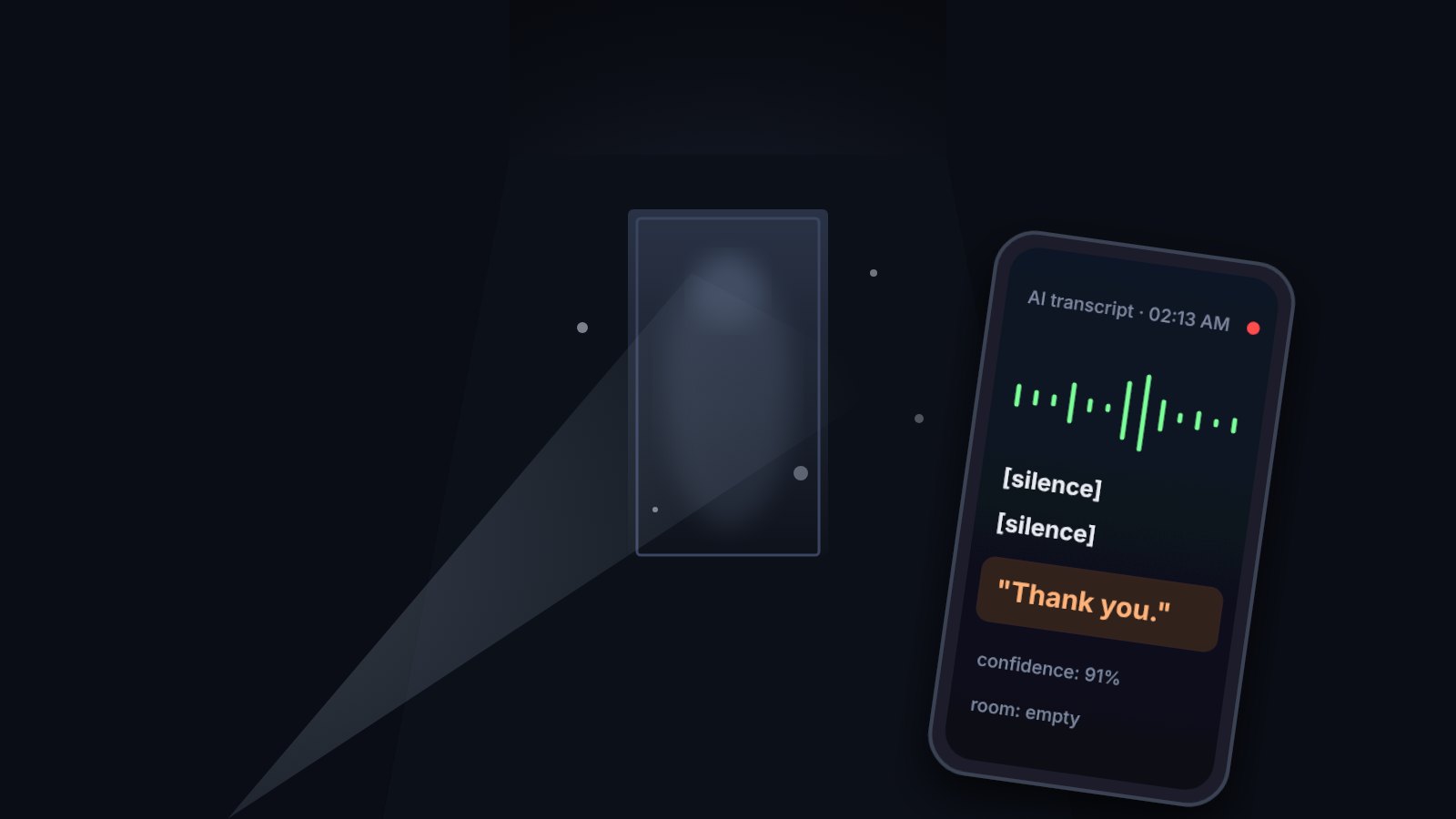
Speech-to-text AI is trained to turn sound into words, and it really wants to find words. A 2024 study from Cornell University looked at one of the most widely used transcription tools and found that roughly 1% of its transcriptions contained whole phrases that nobody had said. Those invented phrases were more likely during long pauses and silences. In one test, the AI transcribed a completely silent file as "Thank you."
Now think about what a typical ghost-hunting recording is: long stretches of silence, room noise, hiss and the odd distant sound. That's close to the worst possible material to give a transcription AI. If you run it through an AI and see the words "help me" appear, that tells you more about the AI than about the room.
Humans do the same thing, by the way. Our brains are wired to find faces in clouds and voices in noise, and psychologists have a name for it: pareidolia. AI didn't invent the problem. It just does it faster and with more confidence.
The other side: AI makes very convincing ghosts
If AI isn't great at finding ghosts, it's frighteningly good at making them.
Every October, social media fills up with "real footage" of figures in hallways and faces at windows. Last Halloween, a cute clip of an opossum being scared off a candy bowl by a cackling witch decoration went viral. The News Literacy Project's fact-checkers later confirmed it was AI-generated.
A few tell-tale signs to check before you share a spooky video:
- The timestamp on the "security camera" is jumbled, or the numbers don't make sense.
- Objects appear and disappear between frames.
- A smudged corner, where a watermark from an AI video tool may have been blurred out.
- Nobody credible has reported it. A genuinely unexplained video would be big news.
If you go ghost hunting this Halloween
Whether you believe or not, a few rules make the night more fun and the "evidence" more honest:
- Keep the original recordings. Never let an app "enhance" or "clean up" the audio before you've listened to the raw file.
- Make a control recording. Record a few minutes in a normal, empty room first, so you know what your phone's own hiss and hum sound like.
- Write down what's around you: traffic, pets, fridges, people in the next room.
- Treat AI as a filter, not a judge. Let it point you to interesting moments, then use your own ears and common sense.
- Share the raw file along with your clip, so others can check it.
From old castles in Europe to Bhangarh Fort in Rajasthan, people have been telling ghost stories for as long as there have been dark corridors. AI won't settle the argument. But used honestly, it's very good at one thing: making sure the stories we tell are the interesting ones, and not just a moth in front of an infrared camera.
Further reading: AI speech-to-text can hallucinate violent language (Cornell University) · Halloween witch surprising opossum video is fake (Daily Herald) · How artificial intelligence is poised to change paranormal research (Higgypop)