Made in India: the startups building humanoid robots
From Hyderabad to Kochi, Indian start-ups are designing and building their own humanoid robots for factories, hospitals and banks. Two of them, and why it matters.
By Duangduean Studios
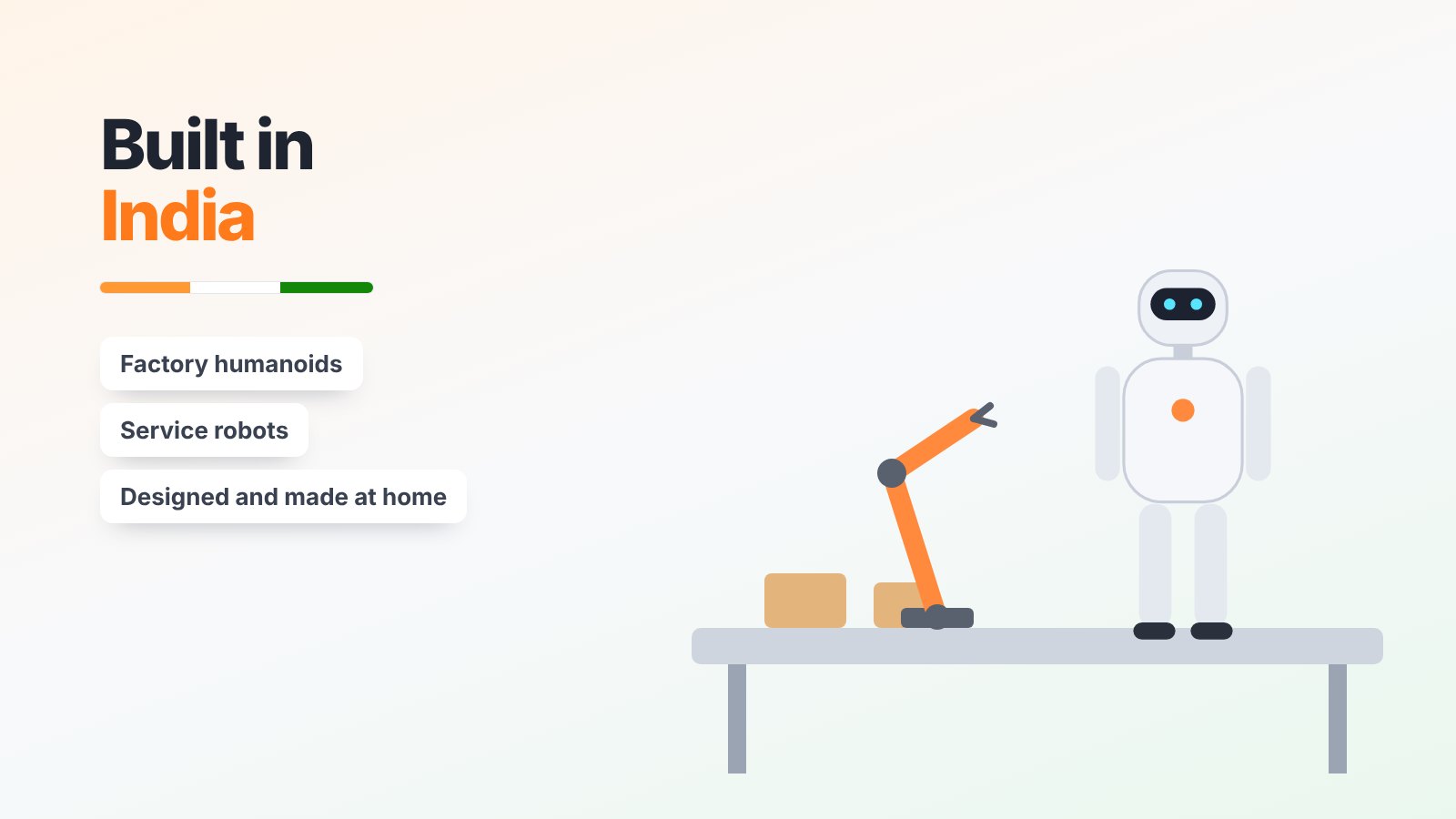
When people talk about humanoid robots, the names are usually American or Chinese: Tesla, Figure, Boston Dynamics, Unitree. But some of the most interesting work is happening much closer to home, in Indian start-ups building robots from scratch.
Here are two worth knowing about.
Perceptyne, Hyderabad: humanoids for factory floors
Perceptyne was founded in 2021 in Hyderabad, and it builds AI-powered humanoid robots for factories. Not dancing demo robots, but machines meant to handle the varied, fiddly tasks that traditional factory robots struggle with.
In March 2026 it raised ₹30 crore (about $3.6 million), including support from T-Hub and the Startup India Seed Fund, plus investors such as India Quotient. Its customers include automotive and electronics manufacturers, two industries where India is growing fast.
That focus makes a lot of sense. India's electronics manufacturing has boomed, and factories need automation that can adapt quickly when a product line changes. A robot that can be shown a new task, instead of being reprogrammed for weeks, is exactly what those factories want.
iHUB Robotics, Kochi: from service robots to industrial humanoids
iHUB Robotics was founded in 2022 in Kochi, Kerala, and it designs and manufactures its robots in India: the body, the electronics and the AI.
Its first product, Tara Gen-1, is a semi-humanoid service robot launched in 2024, with versions for hotels, hospitals, schools and banks. About 35 units are already working across three countries, including exports to the UAE and Saudi Arabia. Its industrial humanoid, Daksha, is designed to lift loads of up to 25 kg.
In January 2025, iHUB became the first Indian company selected for NVIDIA's humanoid robotics programme. It's now planning an industrial humanoid research centre in Bengaluru, with more than 150 hires over two years, and a school to train students in robotics and AI. Its entry-level systems start at roughly $10,000.
Why this matters for India
There are a few reasons to be genuinely excited:
- Cost. Indian engineering has a long record of making technology affordable, from space missions to vaccines. If anyone can build a useful humanoid at a price smaller businesses can afford, Indian teams are well placed.
- Jobs of the future. Building, programming, repairing and training robots will be skilled, well-paid work. A home-grown robotics industry means those jobs are here too, not just the robots.
- Manufacturing. As more phones and electronics are made in India, local automation companies that understand Indian factories have a real advantage.
- Talent stays. For a long time, India's best robotics engineers had to go abroad to work on this kind of technology. That's starting to change.
Early days, but a good start
Let's be honest about the scale: these companies are raising crores, while some American robot companies raise billions of dollars. They're small, and the road is long.
But every big technology industry starts with a few teams willing to build the hard thing first. It's good to see Indian names on that list.
Further reading: Perceptyne raises $3.6M to build AI humanoid robots for Indian factories (Techleap) · Kerala's iHUB Robotics is teaching robots to see, act, and understand (YourStory)