A WWII flight game with no art files: a Skyfront '43 diary
Every aircraft, mountain and engine sound in Skyfront '43 is made by code. Why we built it that way, and what went wrong when we put it in a web browser.
By Duangduean Studios
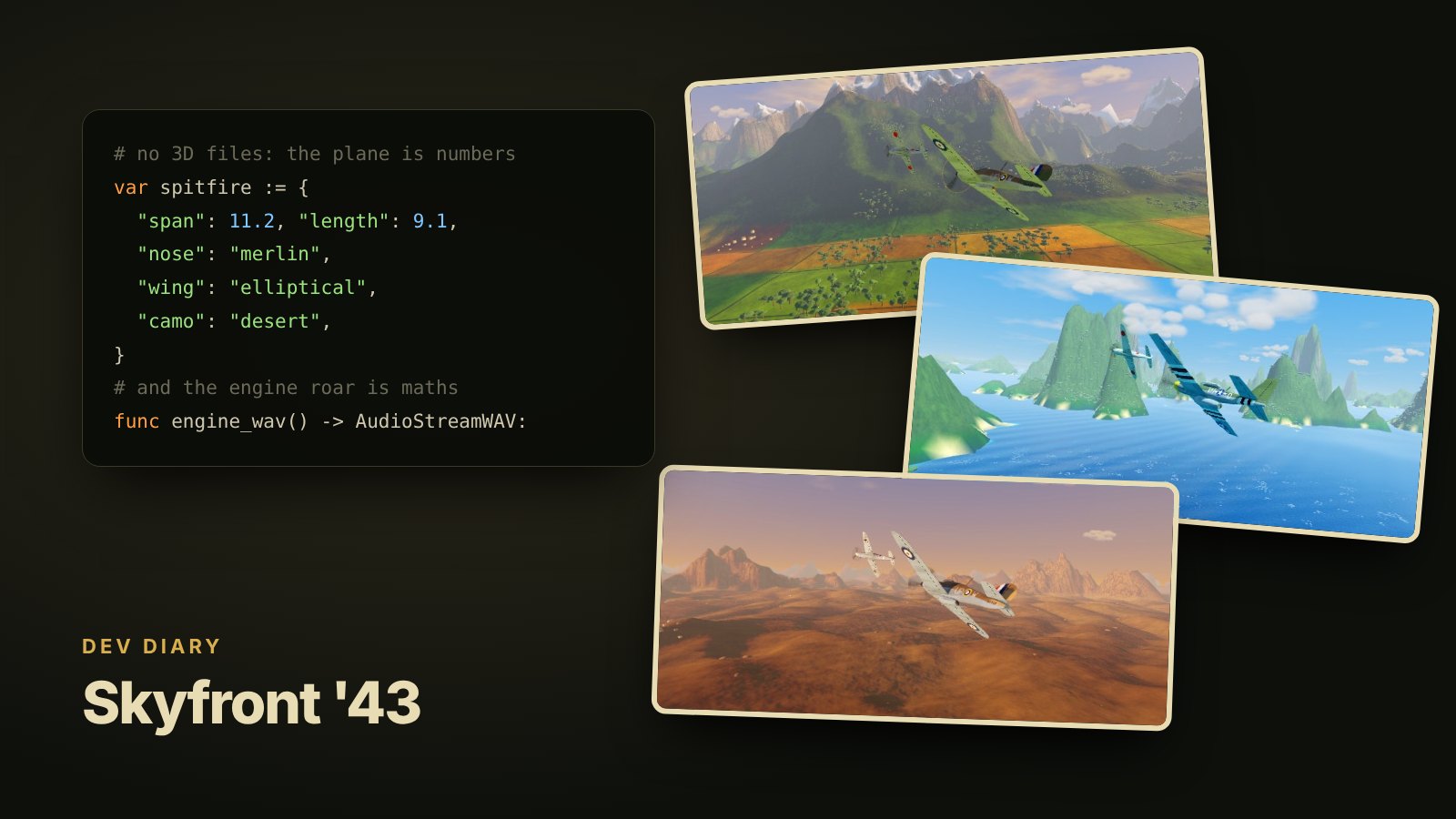
Most games are built from thousands of files: 3D models, textures, sound effects, music. Skyfront '43, our WWII air combat game, has almost none. The planes, the terrain, the clouds, even the roar of the engines are generated by code when the game starts.
People ask why. Here's the honest story, including the parts that didn't go to plan.
Why build everything in code?
It started as a practical decision. We're a small studio. Buying or modelling a dozen detailed WWII aircraft, four complete landscapes and a library of sounds would have cost far more time and money than we had.
So instead, each aircraft is described in numbers: wing span, length, the shape of the nose, where the radiator sits, the paint scheme. The game builds the 3D model from that description. The same goes for the world: mountains, rivers, fields, forests and coastlines are all grown from rules and a bit of controlled randomness.
The sounds work the same way. There isn't a single audio file for the engines or the guns. The game calculates the sound waves when it starts: the low drone of a Merlin engine, the crack of cannon fire, the thump of flak.
The nice side effects:
- The game is small. A tiny download matters on phones, especially with limited data.
- Variety is cheap. A new aircraft is mostly a new set of numbers.
- Everything matches. Because the same rules make everything, the planes, the world and the light all feel like one place.
Four theatres
Skyfront '43 has four theatres of war, each with eight missions:
- North Africa: the Western Desert, 1942
- Indian Subcontinent: the Assam–Burma front, 1944
- Asia Pacific: the Solomon Islands, 1943
- Europe: the Channel and the Ruhr, 1944
The Indian Subcontinent theatre was important to us. The air war over Assam and Burma, around Imphal and Kohima, was one of the hardest campaigns of the war, and it's almost never in games. Flying low over green hills and river valleys there feels completely different from the open desert or the island chains of the Pacific.
There's also a Flight School: about four minutes that takes you from the runway through turning, shooting and dogfighting, and back down to a landing.
Taking it to the browser (and getting humbled)
On Android and Windows, the game runs well. So we thought putting it on our website, playable in a browser, would be easy. It wasn't.
The first browser version froze for a minute or more on many laptops, especially ones with built-in Intel graphics. The cause took a while to find. Before a graphics chip can draw anything, it has to prepare a small program for each kind of surface and light. Our menu alone was asking for 126 of them, mostly for a 3D hangar we were building in the background "to save time later". On some laptops in a browser, each one takes a noticeable moment, and the picture simply stops while it happens.
The fixes were mostly about doing less: no hangar until you open it, no extra lamps or shadows in the browser version, and simpler lighting. The menu now needs 25. We also compressed the game's pictures, which cut the download for the game data from about 10 MB to 3 MB.
The lesson, which we keep relearning: test on ordinary hardware, early. Our development machines were far too forgiving.
What's next
We're working on making the first flight in the browser faster, and on getting the Android version ready for the Play Store. If you try the game, we'd love to hear what you think, especially if something goes wrong. Bug reports from real players are worth more than a week of our own testing.
Play Skyfront '43 in your browser. It works best on a computer with a mouse.