Tesla's "flying car" is here. Here's what it can really do
The new Roadster jumped over a Cybertruck on rocket-style air thrusters. We separate what Tesla actually showed from what is still a promise.
By Duangduean Studios
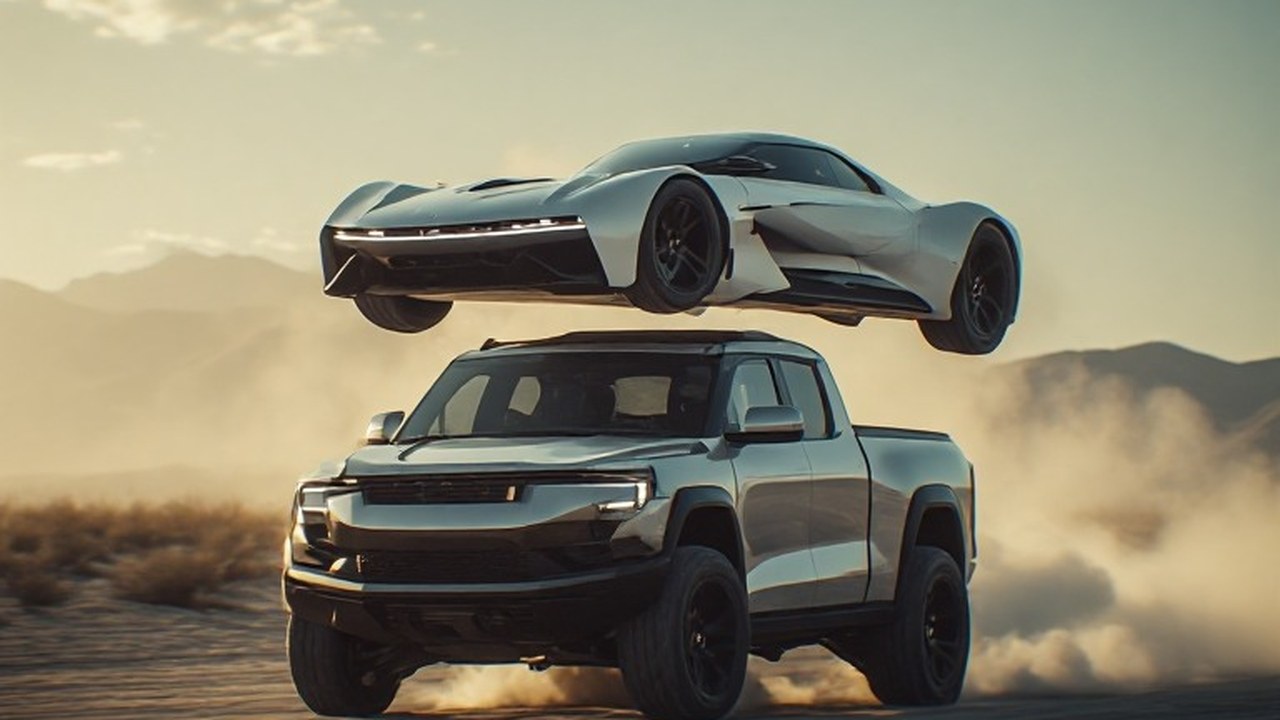
On 15 October 2026, Tesla finally showed the new Roadster, nine years after it was first announced. And yes, it left the ground.
At SpaceX's test site near Waco, Texas, the car climbed an upside-down ramp, spun, and used bursts of air to hop over a Cybercab, a Cybertruck, a Tesla Semi, a Model Y and a Model 3, then landed on its wheels. Elon Musk's line for the night: "This will be the actual car that's on the roads."
So is this the flying car we were promised in cartoons? Not quite. Here's what's real and what isn't yet.
How does a car "fly"?
There are no wings and no propellers. The trick is cold-gas thrusters: small nozzles that blast out highly compressed air, the same basic idea spacecraft use to steer.
- The top version has 10 thrusters around the body.
- They are fed by about 600 litres of compressed air, stored in carbon-fibre pressure tanks packed into every spare gap in the car.
- The tanks can be refilled, so the stunt can be repeated.
Think of it less like a plane and more like a very powerful jump. It can lift, hop and twist for a moment. It cannot cruise through the sky.
Three versions, three prices to reserve
| Version | Seats | Tesla calls it | Reservation |
|---|---|---|---|
| Performance | 2 | "road ready" | $50,000 |
| Thrust | 2 | "race ready" | $250,000 |
| Rocket | 1 | "air ready" | Invite only |
Tesla claims all three get around 300 miles (480 km) of range, a top speed above 230 mph (370 km/h), and 0 to 60 mph in about one second, quicker than any production car today. Only the Rocket gets the full set of 10 thrusters.
Note what's missing: a real price. Those figures are just deposits to hold your place.
What we know vs what we don't
Shown on stage
- The car jumped, spun in the air and landed on its wheels.
- The car is a joint Tesla–SpaceX effort.
- Musk says Tesla will build it in 2028, and reservations opened the same day.
Not shown or not confirmed
- How high or how long it flew. Reports describe a brief hop, not sustained flight.
- Who was driving. The demo car flew with no one inside. Musk said that was "to make sure we don't kill anyone."
- Any approval from regulators. Nothing shown has been certified by aviation or road-safety authorities, and Tesla hasn't said whether it will even seek that.
- Independent tests. The one-second 0–60 figure comes from Tesla, not from an outside tester.
Safety is "not the main goal"
This is the part that surprised people. Musk himself said safety is not the main goal of the new Roadster. He called it "the best of the last of the human-driven cars", a toy for thrill-seekers rather than a family car. On a podcast he went further: if safety is your top priority, don't buy it.
There's also a technical worry. The carbon-fibre pressure tanks it uses are the same type linked to some SpaceX rocket failures. Storing hundreds of litres of high-pressure air inside a car that crashes on public roads is a new kind of engineering problem.
The nine-year wait
Some patience is in order, because the Roadster has a history:
- 2017: Revealed. Tesla took $50,000 deposits, plus 1,000 "Founders" reservations at $250,000.
- 2020, 2021, 2023, 2024: Delayed each time.
- 2025–2026: The reveal date slipped to the end of 2025, then 1 April 2026, then 1 October 2026 (weather), before finally happening on 15 October.
So when Musk says 2028, it's fair to treat that as a target, not a promise.
Will it ever come to India?
Almost certainly not soon. Tesla only began selling cars in India in 2025, and a car with rocket-style thrusters would need approvals that don't exist yet, here or anywhere else. For now, the flying Roadster is something to watch on YouTube, not something to book.
Our take
What Tesla showed is genuinely impressive engineering: a car that can jump over a truck on air alone is not nothing. But it's a stunt car, not a flying car. It hops rather than flies. The real tests are still ahead: a price, deliveries, and whether any government will let it on the road with those thrusters switched on.
If it ships in 2028 and works as shown, it'll be the wildest car ever sold. If not, it joins a long list of Musk timelines that moved. Either way, it's a good reminder to read past the headline.
Sources: TechCrunch · CNN · Tech Insider: confirmed vs unproven · NBC News