Ramayana and Ancient Egypt: Fascinating Similarities, but Is There a Connection?
Rama and Ra, Sita and Sia, flying vehicles, sacred primates and limestone: exploring the similarities between the Ramayana and ancient Egypt, and what historical evidence actually supports.
By Duangduean Studios
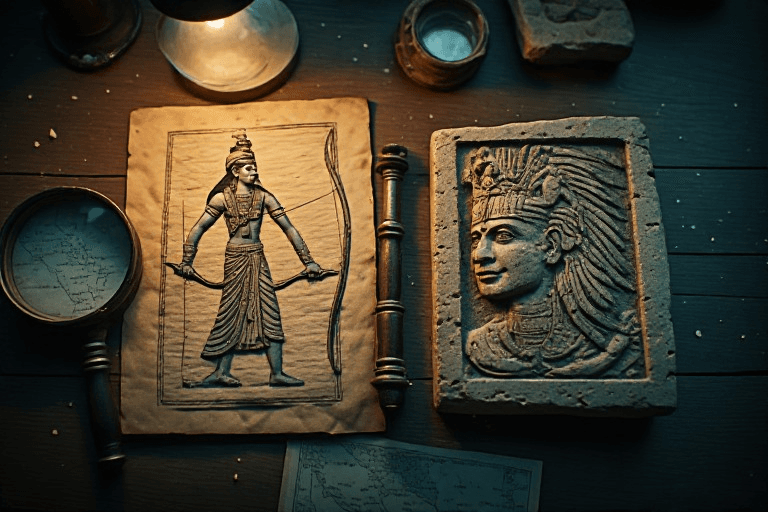
Rama and Ra. Sita and Sia. Flying vehicles, sacred primates and limestone landmarks. Here is what these comparisons reveal—and where the evidence stops.
Put images from the Ramayana beside those of ancient Egypt, and questions begin to form.
There is Rama, and there is Ra. Sita’s name sounds close to Sia. Ravana possesses the flying Pushpaka Vimana, while photographs of Egyptian carvings seem to show aircraft. The Ramayana has an army of vanaras; Egyptian religious art features baboons.
Even the landscapes invite comparison: limestone occurs along Ram Setu, while Egyptian builders used it to construct the Great Pyramid.
Taken together, these details make an intriguing subject. But do they point to a shared history?
The sources examined for this article do not establish a direct connection between the Ramayana and Egyptian religion. They do reveal something worth exploring: similarities with different explanations, alongside archaeological evidence that India and Egypt were connected through travel and trade.
Rama, Ra and Ramesses
The resemblance between “Rama” and “Ra” is easy to notice.
In the Ramayana, Rama is the prince of Ayodhya whose exile, separation from Sita and conflict with Ravana shape the narrative. In Hindu tradition, he is revered as an avatar of Vishnu. Smithsonian National Museum of Asian Art
Ra, also written Re, belongs to Egyptian religion and is associated with the sun, creation and the renewal of life. His name also appears within Egyptian royal names. University College London records spellings of Ramesses II’s name that include ra-ms-sw. American Research Center in Egypt, University College London
Those similarities in English spelling can start a conversation. Establishing a relationship between the names would require a linguistic trail: evidence of borrowing, changes in pronunciation and records connecting the languages at identifiable dates.
The sound of the names alone cannot show that Ramesses was named after Rama.
Rama’s Suryavansha and the Egyptian “Son of Ra”
A more meaningful parallel than the sound of their names is the way both traditions connect kingship with the sun. Rama belongs to the Suryavansha, or Solar Dynasty: the traditional genealogy recited in the Ramayana traces his Ikshvaku lineage through Manu to Vivasvan, the sun. Egyptian pharaohs, including Ramesses II, likewise expressed a divine solar relationship through the royal title “Son of Ra.” This offers a striking comparison between two traditions of sacred kingship. However, “Son of Ra” was a title used across Egyptian dynasties, rather than evidence of a “sun clan” identical to Rama’s lineage. The parallel does not establish shared ancestry or historical borrowing. , ,
Frequently asked questions
Is there a connection between the Ramayana and ancient Egypt?
No direct connection has been established. There are interesting resemblances, such as Rama and Ra or Sita and Sia, and archaeology shows India and Egypt were linked by trade, but no evidence shows the Ramayana reached Egypt or that the two traditions share an origin.
Is the Egyptian god Ra related to Rama?
The names sound alike, but similar sounds are not evidence. Proving a link would need a linguistic trail of borrowing and dated records. The stronger parallel is that both traditions connect kingship with the sun: Rama's Solar Dynasty and the Egyptian royal title 'Son of Ra'.
Do the Abydos carvings show a helicopter?
No. The shapes at the Temple of Seti I at Abydos come from later hieroglyphs carved over earlier ones. Scholars call this a palimpsest, and the overlapping signs can look like modern vehicles, especially in cropped photos.